
Coinchange 2025 Year-In-Review


Coinchange 2025 Year-In-Review
This is an internal review of what Coinchange has accomplished throughout the year. For a comprehensive analysis of the industry in 2025, click here.
Executive Summary
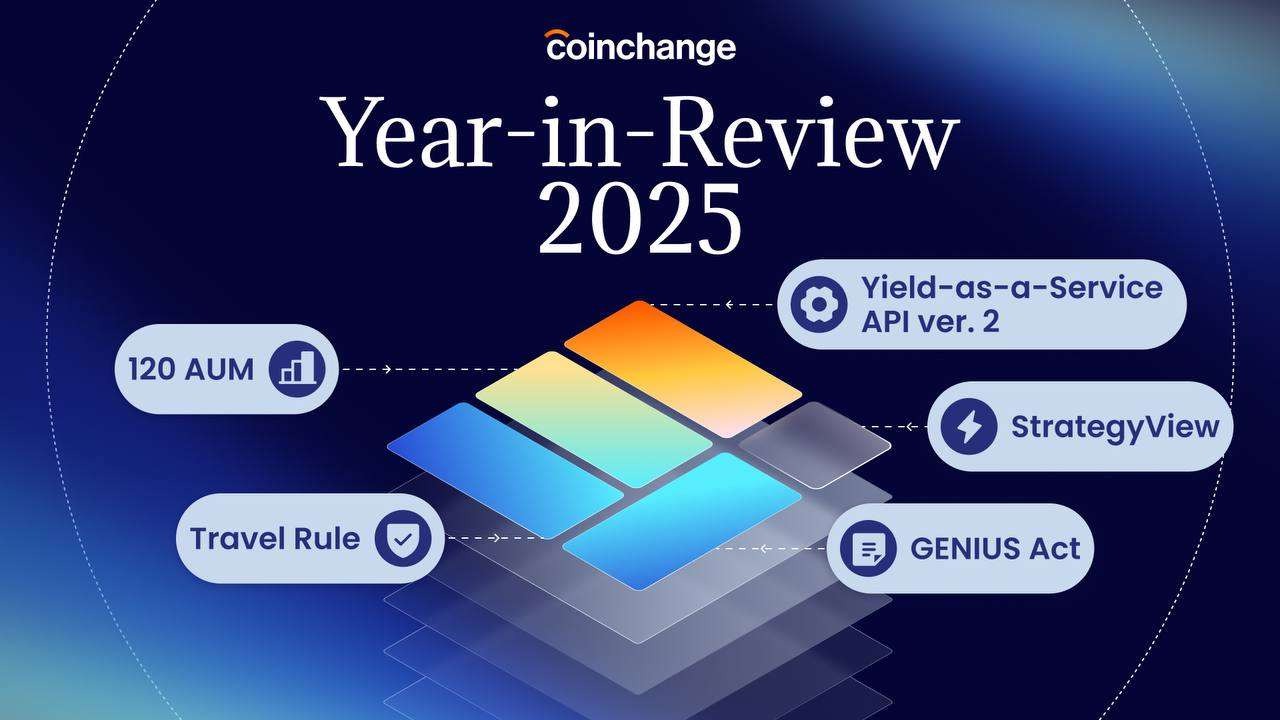
2025 marked the decisive turning point for institutional participation in digital assets. The defining shift was not whether digital assets should be adopted, but how they should be integrated safely, compliantly, and within existing institutional frameworks. Regulatory clarity across multiple jurisdictions resolved long-standing uncertainties, removing the primary barrier that kept many institutional allocators on the sidelines. As clarity strengthened, institutional appetite accelerated. Capital is no longer searching for speculative yield — it is demanding compliant, risk-managed, infrastructure-grade solutions.
Coinchange was positioned at the center of this transition. Over the year, the firm scaled institutional-grade infrastructure to enable compliant, risk-controlled exposure to digital asset yield and capital-efficient portfolios. Coinchange assets under management reached $120 million, supporting partners across fintech, treasury, and exchange sectors. The partner ecosystem expanded across regulated financial institutions, enterprise platforms, and digital asset service providers, leveraging Coinchange infrastructure primarily via API integrations and vault-based deployments.
Coinchange facilitated institutional capital allocation and strategy throughput in 2025 through actively managed, multi-manager, risk-screened portfolios deployed across compliant venues. These portfolios, accessed via API or dedicated vault infrastructure, enabled partners to offer stablecoin income, capital-preserving strategies, and risk-managed exposure without building internal digital asset expertise.
Entering 2026, execution priorities are clear. First, expanding on-chain settlement mechanisms to further reduce counterparty exposure. Second, building tokenized fund infrastructure to deliver regulated investment vehicles aligned with institutional distribution channels. Third, scaling the partner ecosystem globally to serve banks, fintechs, corporate treasuries, and exchanges seeking compliant digital asset strategies. The objective remains unchanged: to bring Wall Street infrastructure to Main Street.
Market & Regulatory Landscape
This section frames the environment that made 2025 the institutional tipping point. Institutional demand accelerated not because of hype cycles or price appreciation, but because the structural barriers — regulatory clarity, compliance frameworks, custody maturity, and policy direction — were materially resolved.
Regulatory Breakthrough
2025 delivered substantive policy advancement across major jurisdictions. The Responsible Financial Innovation Act clarified core federal treatment of digital asset operations in the U.S., improving certainty for institutional participants. The GENIUS Act established coordinated oversight for stablecoins across federal and state frameworks, explicitly recognizing the strategic financial role of well-regulated stablecoins. In Europe, MiCA provided comprehensive licensing structure for digital asset service providers, creating uniform regulatory expectations across EU member states. Basel III Group 1b classification positioned regulated stablecoins closer to bank-recognized high-quality assets within prudential frameworks. Meanwhile, CARF/DAC8 formalized global tax transparency and cross-border reporting obligations, with January 2026 enforcement deadlines driving system readiness initiatives across the industry.
The global outcome was alignment: digital asset infrastructure is now being integrated into regulated financial architecture rather than operating adjacent to it.
Institutional Adoption
Institutional participation meaningfully expanded. Industry research indicated that more than half of hedge funds now maintain some crypto exposure, with nearly half citing regulatory clarity as the catalyst for entry. A substantial proportion reported willingness to increase allocations contingent upon improved custody, compliance, and risk infrastructure — precisely the domains that matured significantly over the year. This shift represented a transition from exploratory allocations to structured portfolio integration.
Stablecoin Expansion
Stablecoins became the operational backbone of institutional digital asset strategy. USDC surpassed $50 trillion in lifetime transaction volume across more than twenty blockchains. Major payment processors settled tens of billions in volume directly on public chains, demonstrating operational reliability at global scale. Total stablecoin issuance grew from approximately $200 billion to $280 billion, underscoring adoption beyond speculative trading toward payments, treasury management, and settlement infrastructure. Stablecoins are now viewed less as “crypto instruments” and more as programmable cash equivalents.
Market Validation Through Stress
November 2025 market volatility provided a real-world stress test. Significant BTC ETF outflows and leverage concentration highlighted fragilities in directional, leverage-dependent strategies. Institutions reassessed risk frameworks and prioritized yield sources decoupled from speculative market performance. This reinforced demand for delta-neutral, margin-free, capital-preservation strategies, particularly those centered on stablecoins.
Key Insight
Institutional demand evolved decisively: from chasing yield to protecting capital while earning yield. Digital asset strategies are increasingly evaluated on traditional financial metrics — risk profile, drawdown behavior, operational control, transparency, and compliance integrity.
Product Updates
Platform Enhancements
- New flexible investment product architecture to support multiple portfolios, custom fee contracts, and flexible performance views.
- Implementation of regulatory requirements for Travel Rule.
- Added support for multiple legal entities, separate reporting, separate wallet providers, and liquidity provider separation.
- New internal system, StrategyView, to track and report portfolio performance in real-time.
- Support for multiple languages in the web app.
Web & Mobile Experience
- New web app User Experience launched in September 2025.
- New site layouts & product pages.
- Launched redesigned Yield-as-a-Service API (version 2) to support new flexible product architecture, with API test automation.
- Daily performance/earnings history view for clients.
- Optimized user dashboard and performance graphs load times.
Business Performance & Growth
Coinchange closed 2025 with $120 million AUM/TVL, reflecting continued institutional adoption and scaling of infrastructure services. Growth was driven primarily by institutional partners embedding Coinchange infrastructure.
Partner Ecosystem
Coinchange expanded its institutional partner base across fintech platforms, neobanks, exchanges, and treasury operators. Key partner successes included:
- Borderless
- Cryptomarket
- Rockbridge
- Utila
- Kanga
Partners integrated Coinchange yield, vault infrastructure, or portfolio exposure via API, delivering enhanced financial products to their customers while maintaining custody and compliance alignment. The business model emphasized institutional enablement rather than end-user servicing.
Product Evolution
Coinchange actively expanded its institutional product suite:
- Fixed-income style stablecoin strategies
- Yield portfolios
- Managed investment portfolios
All portfolios are actively managed using Coinchange portfolio management and risk management infrastructure. Institutional strategies now include multiple portfolio types across DeFi and CeFi execution environments.
Performance & Risk Analytics
Performance analytics demonstrated consistency across market environments (taking the stablecoin portfolios as an example):
- Sharpe ratio: 2.75 - 3.17
- Max drawdown: -1.8 - -4.3%
- Yield APY: 10-35%, depending on the portfolio
Risk Management, Compliance & Regulatory Posture
A. DeFi Risk Assessment Framework (DRAF)
Coinchange operates a proprietary risk framework covering:
- 90+ risk datapoints
- 37 graded questions
- Smart contract, liquidity, decentralization, and operational risk
- Deployment gating
- Transparency
B. Operational Due Diligence & Custody
- Fireblocks + Copper integrations
- Segregated wallets
- Third-party NAV validation
- Real-time monitoring
- Governance and background screening
C. Insurance & Safeguards
- Smart contract risk insurance
- Stablecoin depeg coverage
- Custody protection
Transparency maintained regarding what is not covered.
Content, Thought Leadership & Positioning
Coinchange transitioned research focus toward institutional utility, producing frameworks, regulatory interpretation, and strategy execution insights. Key 2025 outputs included:
- 2025 LATAM Crypto Regulation Report
- Three Bills of Legislative Clarity: Can the U.S. Become the Crypto Regulation Leader?
- Stablecoin Usage Surging: Use Cases & How to Capitalize on It
- When Only 1 in 10 Crypto Assets Earn Yield: The On-Chain Opportunity You’re Overlooking
- Why Institutions Are Capturing 12-15% While Retail Earns 5% on Stablecoin Yield
- And more.
Executive leadership participated in institutional conferences and regulatory forums. Coinchange was cited in CB Insights as one of 172 leading stablecoin companies.
Partner enablement content expanded significantly, including:
- API docs
- Compliance documentation
Events & Industry Engagement
We have attended a total of 41 events in 2025.
Out of the said 41 events, we have hosted or co-hosted 9 of them.
Our CEO, Maxim Galash, was the speaker at the panel “The Future of Asset Management: Institutional and Retail in a Digital Asset World” in MERGE Madrid.
2026 Execution Priorities
- On-chain settlement — reduce counterparty exposure through direct settlement mechanisms.
- Tokenized fund infrastructure — deliver regulated investment vehicles for institutional distribution channels.
- Scale partner distribution — expand globally across banks, fintechs, treasuries, and exchanges.
Read More:
2025 LATAM Crypto Regulation Report
Stablecoins for Banks: The Strategic Solution for Financial Institutions in 2025
Why Institutions Are Capturing 12-15% While Retail Earns 5% on Stablecoin Yield
Latest articles





Coinchange 金融有限公司
大学大道 261-250 号
加拿大安大略省多伦多 M5H 3E5
Coinchange 金融公司
公司信托中心 1209
奥兰治圣威尔明顿,
19801 年美国
Coinchange 金融服务公司Z.O.O。
Grzybowska 80/82/700
00-844 华沙,波兰
注意:加密资产不是法定货币,不受政府支持,在Coinchange持有的加密账户不受联邦存款保险公司或SIPC的保护。加密资产的价值不是静态的,可能会大幅波动。并非所有产品和服务都可在所有地理区域使用,并受Coinchange的适用条款和条件的约束。特定产品和服务的资格取决于Coinchange的最终决定。我们产品的价格可能会发生变化。本网站上的任何内容都不应被解释为任何行动的建议。Coinchange在美国金融犯罪执法网络(FinCEN)注册为货币服务企业(MSB),注册号为31000304503627。